| Hugh David Grisdale Birkett (1919 – 2002) Lapworth Cabinetmaker Lapworth History DEC. 26 – Part 2 Peter A J Hill |
PART 2. The Mission Abroad 1944 to 1947
In the last article we saw that Hugh Birkett had been accepted to work abroad in February 1944 as a social worker on the National Social Reconstruction Scheme. The war in Europe was to continue raging until May 1945 with Hugh assigned to work with refugees displaced by the war. He was sent on a convoy travelling to Egypt and from there via Cairo to go to the British refugee camp for Yugoslav refugees at Suez.
The convoy was attacked enroute but survived with Hugh arriving in Cairo in March 1944. He transferred to the El Shatt Refugee Camp in the Sinai desert which held some 30 000 refugees. Here he worked in the workshops for displaced persons making new friends in the process. After a while, the British authorities recalled him to Cairo to learn to drive all the vehicles at their disposal. Then, in June 1944 due to his efforts, he was made an officer and placed in full charge of the workshops at El Shatt.
In the late autumn of 1944, he was told that he would be relocated from Egypt onto another mission, this time in Greece. The war was entering a new phase with the withdrawal of the German forces from there in October. He joined a new convoy in December 1944 sailing from Alexandria to Athens. Unfortunately, Civil War had broken out in Greece so he, along with other members of the team, were not allowed to land in Greece for their own safety. They eventually disembarked on Christmas day 1944. It was also decided for their own safety that their military style uniforms should be discarded; the only source of clothing was what they had with them in Red Cross parcels and clothes sent from America that they had on board the convoy.
However, events moved on so that by Easter 1945 Hugh was based at the town of Volos, some 200 miles north of Athens, charged with organising the distribution of food and clothing to the 160 outlying villages and to some 30 000 children. Weather conditions with heavy rain and snow in the mountains made travel conditions almost impossible by vehicle and presented a constant challenge. Hugh was now made the representative of the International Red Cross (IRC) and the United Nations Relief and Rehabilitations Administration (UNRRA) in Greece.
In January 1946 his role changed whereby he was made Regional Shelter Engineer tasked with planning the reconstruction of homes for displaced persons in Greece. These had been destroyed or burnt down by the occupying German forces. During April 1946 he learned that his father, Thomas Birkett, had been made chairman of Midland Electric Manufacturing Co (MEM) the company that he had joined in 1920. Thomas had become managing director in the 1933 and had helped to steer the company through the war years.
According to Hugh’s nephew, Kit Mayers, whilst working in Greece Hugh made friends with a Greek family and had taken a shine to their daughter. However, under what circumstances we do not know, she died or was killed; a potential love interest in Hugh’s life was just as suddenly extinguished. Hugh kept many mementoes in his possession, both from his parents and from elsewhere. Amongst these, seen by the writer, are photographs of a Greek family and a girl with dark hair; it is most likely that this was Hugh’s Greek girlfriend.
Hugh’s work in Greece concluded in May 1946. He was given leave to return home. Back in Lapworth he wisely applied for and obtained an International Driving Permit (22nd May 1946) as by June he learned that he was to be relocated to Czechoslovakia. He was to join a Swiss team from Berne which might just involve some driving.
Hugh travelled to Berne where he joined a team from the Swiss Service Civil International for Peace (SCI). He was allocated a large covered lorry and covered trailer with Swiss Red Cross markings on it to drive with equipment to Czechoslovakia. He was accompanied by two Swiss colleagues, Elizabeth Brenner, a German speaking teacher, and Hansruedi Lüthi, a German speaking painter and decorator. The lorry not only carried equipment for use on the mission but also presents for the people (both young and old) in Czechsoslovakia. Hugh drove them successfully through the various military zones of post-war Europe (French, British, American and Russian) to Prague. He was the principal driver for the length of the mission driving thousands of miles during 1946.
The Swiss and Czech team assembled on the 8th July 1946 in Prague along with the ‘Anglican’ (Englishman) Hugh Birkett. Their number was 18 under the leadership of the Swiss, Friedrich Lutz. They reported to the prominent Czech humanist, pacifist and social worker, Přemysl Pitter, at Milíč House in Prague. This was a foundation he had set up in December 1933 to provide after school activities and care for the poorest children in Prague.
Initially, Hugh and the team went some 235 miles east of Prague to the Opava/Ostrava district within the Moravian-Silesian Region to a small village called Štítina where they were based. They also worked in nearbyHrabyně. This area had suffered terrible destruction from some of the most ferocious final tank battles between Russian and German forces at the end of the war in April/May 1945. The team arrived in Štítina on the 13th July 1946. Here they worked demolishing ruined buildings and reconstructing homes along with the construction of a temporary barn for the mayor of Štítina to house the incoming harvest. Their activities attracted the attention of the Communist Party newspaper, Nová Svoboda (New Freedom), which ran an article on them along with Czeskoslovesky rozhlas (Czech language radio) which interviewed them about their mission. They also helped with the harvest and the transport of children for resettlement from Southern Moravia. Their work ended in Štítina and the Opava/Ostrava district in October 1946 when they returned to Prague.
At the end of the war, between 1945 and 1947, Přemysl Pitter and his colleagues undertook a daring rescue operation, ‘Operation Castles’, specifically for orphaned children from Nazi concentration camps and the Czechoslovak internment camps. Children aged between 3 and 14 years, the children of dead Jews or exiled Germans, were taken and sheltered in five castles around Prague to give them health and social care. Where possible, research was undertaken to reunite children with their relatives across Europe. Over the two-year period that the scheme ran over 800 children were rescued. From October into mid-December Hugh and some of the team members were involved in helping Přemysl Pitter with this project. They were tasked with converting the accommodation to better serve the needs of the children in these orphanages. It was during this time, in November 1946, that Hugh proposed to team member Elizabeth Brenner who was helping to look after the youngest children.
The last four (including Hugh) who had stayed to work with Přemysl Pitter from Milíč House in Prague left on the 16th December 1946. Hugh drove them back to Switzerland through snowy conditions. They took some orphaned children with them to reunite them with relatives in Munich on the way. Hugh then stayed on with Elizabeth in Switzerland over Christmas. The new year 1947 was to bring new challenges for Hugh Birkett.
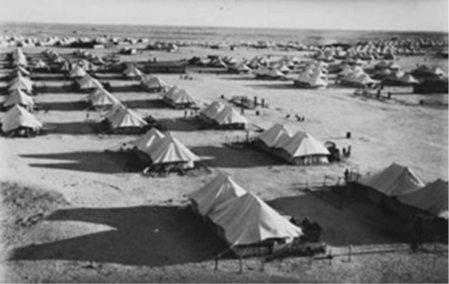
El Shatt Yugoslav Refugee Camp Suez 1944
[https://alchetron.com/El-Shatt#el-shatt-26269c8f-67b8-4f75-9af2-64144d6893f-resize-750.jpg]
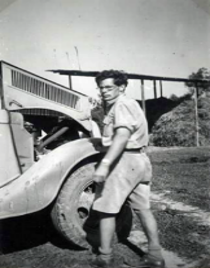
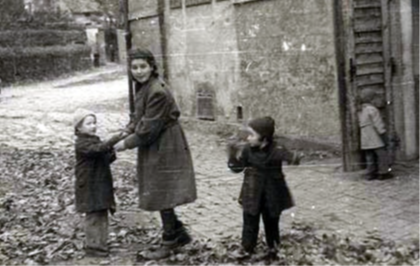
Hugh Birkett in Štítina & Elizabeth Brenner at Schloss Kamenice Czechoslovakia 1946 [Swiss Service International Archive]
If you wish to discuss this article please contact: Peter A J Hill tel. 01564782218