| Hugh David Grisdale Birkett (1919 – 2002) Lapworth Cabinetmaker Lapworth History NOV. 26 – Part 1 Peter A J Hill |
PART 1. The Early Years 1919 to 1944
In 2011 I began to research the life and work of Lapworth cabinetmaker Hugh Birkett. Little did I realise then where it would lead me. Years of research, meeting and visiting people around England who commissioned his work, contact with and interviewing people who knew him well, who had recollections to share and with two of his relatives. Access was granted to the surviving diaries his mother had kept and to the sale catalogue produced by Bonhams in 2002 of all his possessions. John Makepeace OBE, inspired by Hugh’s work as a child, wrote me a special piece about Hugh. Access was given by numerous people dealing in the sale of fine English Art & Crafts furniture to see their collections. There were many, many emails to and from people and very memorable visits to people and places in the Lickeys, Cotswolds, Warwickshire, London, East Anglia and the Lake District in the pursuit of the Hugh Birkett story.
In 2022 I published what I thought would be the final chapter of my book on Hugh Birtkett. Then, totally unexpectedly at Christmas 2024, a chance email to the Lapworth History website from an archivist in the Czech Republic opened up a whole new source of information. This has now been written up with information never before in the public domain about Hugh, where he was, what he was doing and about what was to be the major love story of his life during 1946-47. This series of articles gives an outline of the Hugh Birkett story which I hope you will find interesting to read.
Hugh Birkett from Lapworth was to become one of the leading cabinetmakers of the 20th century working in the Arts & Crafts tradition with his work strongly influenced by the Cotswold School of Furniture. He was born in Solihull on the 5th January 1919 and christened Hugh David Grisdale Birkett, the second son of Thomas and Anne Birkett. They lived at Homewood, Whitefields Road, Solihull, Warwickshire along with Mark his brother (b. 1917) and his stepsister Marjorie (b. 1898). His father, Thomas Birkett, had previously been married to Maggie Laing (m. 1895 in London) who contracted TB whilst they were living in Erdington. They moved to the Packwood area for the cleaner air, but sadly she died in 1908 and was buried in the churchyard at Packwood Church.
As a young boy Hugh Birkett grew up in a home filled with some of the finest products of the the Arts & Crafts Movement both from Birmingham and the London area. His father was an avid collector of first edition and private press books and had amongst his collection a copy of the William Morris Kelmscott Chaucer. Thomas was a member of the Birmingham Guild of Handicraft from 1896 rubbing shoulders with other notable members whom he knew well such as Albert Edward Jones (A.E. Jones Silversmith) Bernard Seigh and Arthur Stansfield Dixon. The latter was the chief designer and head of metalwork at the Guild workshops. Thomas had his own workshop in the Birmingham Jewellery Quarter. Hugh’s mother, Anne Stubbs, was an award-winning gold medallist student from the Birmingham Municipal School of Art who was taught by the architect William Bidlake amongst others. In 1908 she was commissioned by him to design some of the furnishings for the new St. Andrew’s Church at Handsworth which he had designed for the Church of England. She worked as a designer of art metalwork both for A.E. Jones and for Jesson Birkett & Co. Unfortunately, such were the mores of the time, that she was precluded from working as a designer once she married Thomas Birkett in January 1912.
Hugh’s early schooling was first as a border at Wells House and then at Hillstone Preparatory School in Malvern following on his brother. [The latter school was later to be absorbed into Malvern College] His stepsister, Marjorie Birkett, married a local Solihull man, Jack Mayers, in 1928 at Packwood Church leaving home for Leicester, but not for long. They returned in 1929 to stay with the Birketts in Solihull on a ‘temporary basis’ for some considerable time until a house could be found elsewhere.
Another influence on the young Hugh Birkett was his aunt, Kathleen M. G. Stubbs, who lived with the rest of the Stubbs family (his mother’s family) in George Road, Solihull [later demolished to make way for a supermarket]. She was an art teacher and very gifted in calligraphy, illuminating and book binding. The latter skill she was to teach to the young Hugh Birkett over time so that he too became very accomplished in the art form. Later he was to rebind a Kelmscott Chaucer which sold for over £20 000 in the year 2002. His aunt, Kathleen, was a regular exhibitor at the Royal Birmingham Society of Artists (RBSA) exhibitions in Birmingham winning the Lucas Award for bookbinding in 1949; the certificate was signed by the RBSA president, William Bloye.
Amongst the Birkett family friends were the Fleetwood-Walkers who took tea at each other’s houses. In September 1930 Bernard Fleetwood-Walker was commissioned to complete a portrait of Mark and Hugh Birkett (aged 11) at his Harborne home. In 1933 Hugh moved on from Malvern to Leighton Park School (a Quaker school) in Reading in September of that year and was to remain there until January 1937. In 1935 the family left Solihull and moved to a house called Grey Gables on Chessetts Wood Road in the Packwood/Lapworth area. This large family house was designed by the Birmingham architect Edward Francis Reynolds in 1924. Alan Crawford (Birmingham Museum and Art Gallery) described Reynolds as ‘one of the younger generation of Arts & Crafts architects.
In December 1936 Hugh went for an interview at British Tomson-Houston (BTH) at Rugby. The company employed around 10 000 people and specialised in electrical engineering. He was accepted in January 1937 starting his apprenticeship there the following month. In August 1937 he travelled to Paris for a week with his parents to visit the Paris International Exposition. His mother, Anne Birkett, described it as ‘a colossal affair, a month would not be sufficient time to see it all’. During 1938 he learned to drive, taking his parents out to various locations in Warwickshire and driving up Warmington Hill on the Warwickshire / Oxfordshire border (a very steep hill climb!). On the 11th July 1938 he took and passed his driving test and followed this by driving his parents on a touring holiday in July and August 1938 around Scotland and the Lake District.
Hugh was strongly influenced by his time at Leighton Park School with the ‘Quaker tradition that they were strongly opposed to war and sought solutions to conflict without resorting to violence’. (Hill:2022.85) So, he registered as a ‘conscientious objector’ on the 3rd June 1939. At work he had been appointed as planner with BTH as Assistant Air Raid Precautions officer. Meanwhile, his father Thomas Birkett had been appointed Warwickshire County Liaison Officer for refugees with the Birketts being involved helping refugees throughout the war. Then in November 1939 the Conscientious Objectors Tribunal exempted Hugh from military service.
On the 26th June 1940 the first air raid warning occurred in Lapworth. A month later, July 1940, Hugh was instructed by BTH to work on mines. This he could not do and so in July 1940 he, along with other conscientious objectors, had their jobs summarily terminated by BTH. He had to leave immediately and came home. However, he was only home for a few weeks as a family contact asked if he go down to Devon to help a miller who was desperate for someone to work at his flour mill to keep bread production going. Hugh responded and worked with the miller from August 1940 right through to January 1942 although he did suffer a significant hand injury at work which kept him off for a time. When he finished in Devon, he was highly commended by the miller for his work. On the 17th January 1942 he left home for West Ham, London where he joined a Council team tasked with clearing buildings bombed out during the Blitz. Again, whilst at work he suffered an eye injury when falling masonry smashed his glasses. The quick intervention by the local hospital, allowed him to return to work after a few weeks.
For a number years now, Hugh had had a growing interest in wanting to do something to help nationally or internationally with humanitarian aid; the needs of displaced people across Europe were widespread. To this end he attended meetings of the International Voluntary Service for Peace (IVSP) during 1942. Meanwhile in January 1943 Hugh was made up to deputy team leader at West Ham. He applied to work with the IVSP and was accepted in January 1944, leaving his work to undertake training in the Cotswolds. In February 1944 he was notified that he had been accepted to work abroad as a worker on the National Social Reconstruction Scheme working with refugees displaced by the war. To this end in February 1944, he was assigned to a convoy travelling from Southampton to Egypt to go to the British refugee camp for Yugoslav refugees at Suez.
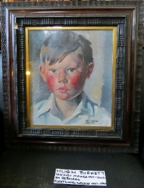
Hugh Birkett aged 11 in 1930 – Fleetwood-Walker painting
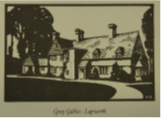
Grey Gables 1936
If you wish to discuss this article please contact: Peter A J Hill tel. 01564782218