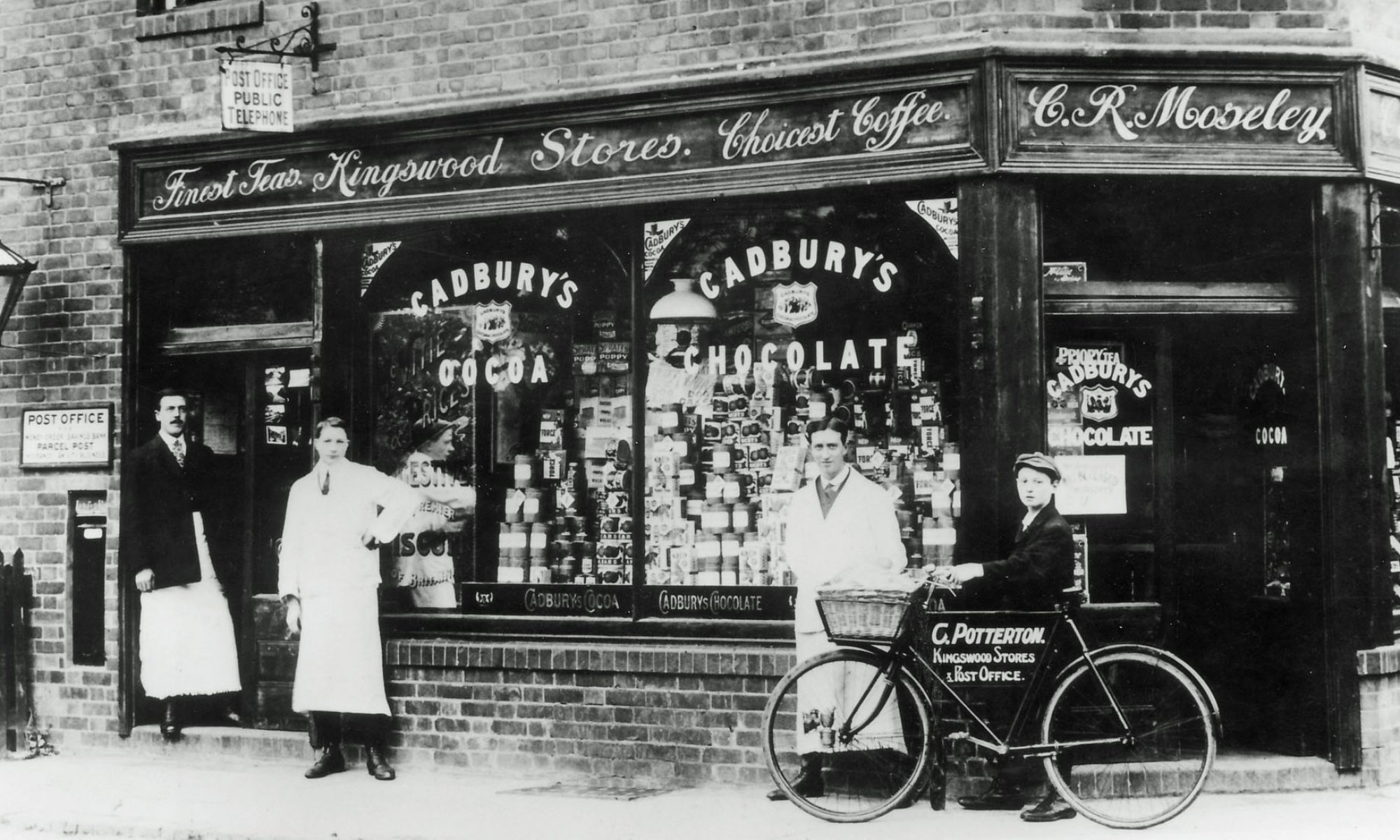
‘…one of the younger generation of the Birmingham Arts & Crafts architects
Lapworth History APR.26 – Part 1 Peter A J Hill
Edwin Francis Reynolds (1875 – 1949)
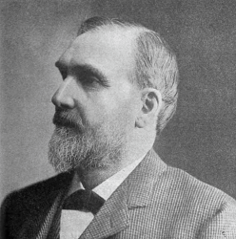
was born on the 30 November 1875 to Alfred John Reynolds and Harriet Porter. His father was a Birmingham manufacturer carrying on a family business started in 1841 for nail manufacture. Their manufacturing was diversified over time becoming famous for its Reynolds 531 Tube Set from 1935. Through marriage and architecture Edwin Francis Reynolds was to become closely associated with the Lapworth area.
He was educated at King Edward’s School in Birmingham and subsequently studied architecture. He worked for a time both in Birmingham and London as an architect’s assistant. He travelled abroad producing drawings of what interested him especially in Greece, Turkey and Egypt which included designs for Neo-Byzantine churches and measured drawings of Islamic architecture in Cairo and Istanbul.
Alan Crawford described Reynolds as ‘one of the younger generation of the Birmingham Arts & Crafts Architects’. (By Hammer & Hand: Birmingham Museum & Art Gallery 1984.56) Reynolds attended the Birmingham School of Art and later became an assistant to William H. Bidlake, the leading Birmingham Arts & Crafts architect of the day. Reynolds was articled to J.A Coussins and F. B. Peacock between 1893 and 1896 and then as an assistant to William H. Bidlake between 1897 and 1899. After this he went to London joining E.A. Runtz and G.M. Ford between 1901 and 1903. He worked as an independent architect from 1905 in Birmingham. He became the Deputy Director of the Birmingham Architectural Association in 1909, was elected licentiate of the Royal Institute of British Architects in 1911 and Fellow of the Royal Institute of British Architects in 1921. He became the consulting architect for the City of Birmingham for Aston Hall and Blakesley Hall.Finally during the 1930s he became a partner with the Birmingham practice of Wood & Kendrick & Reynolds.
Most of his work was in the Midlands where he undertook commissions for large private residences, churches, church furnishings, war memorials and public houses. He undertook numerous commissions in the Lapworth area (Packwood House, large residences, the war memorial and the parish church interior). It was here that Reynolds (33) married Gertrude Mabel Clutterbuck (23) at the church of St. Mary the Virgin on the 22nd June 1909. Gertrude was born in Knowle, Warwickshire, (27 October 1885) and was the daughter of the Birmingham solicitor, Edwin Herbert Clutterbuck (1848–1918) of the law firm Lane, Clutterbuck & Co. The Clutterbuck family lived at the Terets in Lapworth until well into the 1960s. Edwin Reynolds’s own father, A.J. Reynolds (c. 1841-1908), died prior to Edwin’s marriage to Gertrude with the couple living at Hickecroft, Rowington from 1914.
Reynolds was inspired by the work of William Richard Lethaby (1857–1931), a pivotal English architect and highly influential figure of the Arts & Crafts movement along with that of the Birmingham Arts & Crafts architect, Joseph Lancaster Ball (1852–1933), responsible for Winterbourne House (1904) in Edgbaston. Amongst his design portfolio Reynolds designed a large residence for a client at 27 Twatlington Road (1906) Barnt Green which exemplified his strong detailed design; this was something he was to carry through to his work in Lapworth.
The commission which above all established his reputation was the Grade II listed church of St. Germain at Edgbaston (1917).
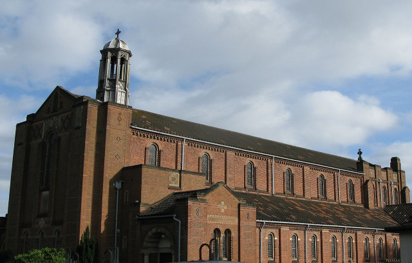
This was designed in the Early Christian/Byzantine style which had enjoyed a revival during this period; a style Reynolds had studied at first hand whilst abroad.
After the cessation of hostilities in the First World War there was call upon architects to design war memorials with Reynolds answering the call with three such projects: Four Oaks, Harborne and Lapworth. He designed the Grade II* listed church of All Saints (1908) at Four Oaks where he was commissioned to design the war memorial (1920). It took the form of a tall plain sandstone Latin cross on a plinth and was Grade II listed. Likewise, to a similar design, Reynolds undertook the design work for the war memorial for St. Peters Church, Harborne (1920) again Grade II listed.
The beautiful Arts & Crafts design produced for the Lapworth memorial in 1920 is not listed.
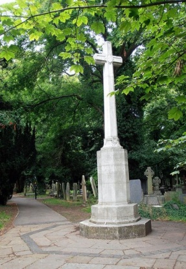
This was an exceptional piece of work situated alongside Tapster Lane and Church Lane. The land, to the north of the church, was donated by Mrs. Whitworth of Broomfield House and gifted to the rector and churchwardens for this use. Reynolds, in a gesture of generosity to Lapworth, waived his fee and the memorial was completed in January 1921. It was dedicated by the Archdeacon of Aston, Canon J. H. Richards, on the evening of 28th April 1921.
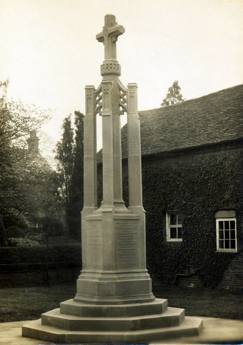
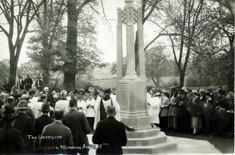
Why was it never listed? After all it lies next to a Grade I listed church with a grade II listed western boundary wall. Also, it was a more complex design beautifully reflecting the Arts & Crafts period.
In October 1938 a terrible storm hit Lapworth destroying the four supporting pillars, the pierced buttresses and toppled the cross. No one at the time was willing to pay for its restoration. A local builder stuck the cross back on the shortened central pillar for free. Listing in the 1990s by English Heritage was not cogniscent of the former beautiful Reynolds design and so it was never listed.
If you wish to discuss this article please contact: Peter A J Hill tel. 01564 782218